
I used to wonder why some websites always ranked higher, no matter how good my content was. That’s when I found the value of SEO competitor analysis. It changed everything. I saw what others were doing, what worked, and where I could do better. In this guide, I’ll show you what I learned from real wins—and a few mistakes. If you’ve ever asked, “Who are my SEO competitors?” or “How do I beat them?”—you’re in the right place.
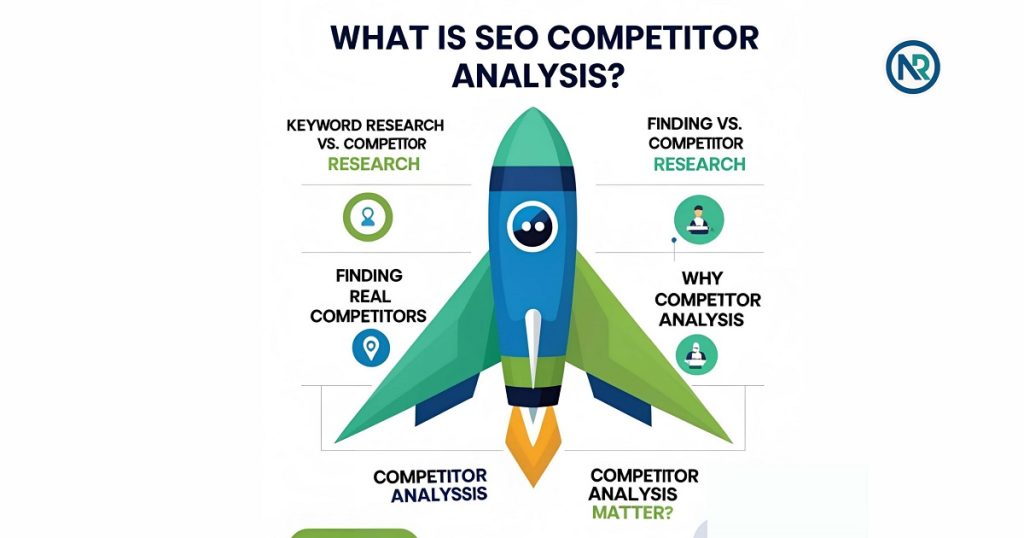
What Is SEO Competitor Analysis?
Let me break it down simply. SEO competitor analysis means looking at who’s already ranking for the keywords you want—and figuring out why. You’re not copying them; you’re learning from them. It’s like watching someone else win a race and then studying their moves so you can build your own winning strategy.
✅ SEO competitor analysis helps you see what works in your niche—and what you can do even better.
Keyword Research vs. Competitor Research – What’s the Difference?
I used to think that doing keyword research was enough. And yes, it’s important—it tells you what people are searching for. But here’s the thing: competitor research tells you who’s actually ranking for those searches—and how they’re doing it.
✅ Keyword research gives you the “what.” Competitor research gives you the “who” and the “how.”
Think of it like this: keyword research is your treasure map. Competitor analysis is spying on the pirates who already found the treasure—and figuring out what path they took to get there.
How I Found Out Who My Real Competitors Were (And Got Surprised!)
When I first started doing SEO seriously, I assumed my top competitors were the big-name companies in my industry. They had more money, more content, and bigger teams.
But when I actually ran an SEO competitor analysis using a tool like Ahrefs, I was shocked. A tiny blog I had never heard of was outranking everyone—including me—for some of the most valuable keywords in my niche. Their content was super focused, easy to read, and genuinely helpful.
✅ That moment changed everything. I stopped guessing—and started analyzing.
Why Is Competitor Analysis Important in SEO?
Back when I started, I picked keywords based on gut feeling. Some worked. Most didn’t. But once I began using SEO competitor analysis, everything changed. I wasn’t guessing anymore. I was learning from people already ranking.
✅ Competitor analysis helps you choose better keywords—ones that actually work.
I also found gaps in my content. My pages were okay, but my competitors had guides, tools, and real value. They weren’t just writing more. They were writing smarter.
✅ It shows you new content ideas that your audience is already looking for.
Then I started noticing patterns. Top-ranking pages had clear formats, focused topics, and helpful answers. I used that insight to improve my own content—and it worked.
✅ SEO competitor analysis reveals what’s working in your niche so you can do it better.
Here’s the kicker: one day, I found a keyword on a competitor’s blog. It had 50,000 searches a month. Their content was average, but still ranking high. I wrote a better version—and landed on page one.
✅ That one keyword brought me thousands of visits. All from one smart analysis.

When Should You Run a Competitor Analysis?
🔹 When You’re Launching a New Website
- Running an SEO competitor analysis before publishing content gives you a big head start.
- It helps you understand who’s already ranking and what they’re doing right.
- You can find proven keywords, formats, and styles to model your own content after.
- ✅ Starting with competitor insights means fewer guesses—and faster wins.
🔹 When You’re Planning a Content Strategy
- Before creating a blog or building topic clusters, check what’s working in your niche.
- Look at the content types: long-form guides, how-tos, listicles, or videos.
- Competitor analysis shows you what your audience is already responding to.
- ✅ This helps you build content that fits demand—not just ideas.
🔹 When Your Organic Traffic Drops or Plateaus
- A traffic slowdown can be a sign that competitors are outpacing you.
- They might be updating their content, building more backlinks, or improving speed.
- Regular SEO audits and competitor checks help you stay competitive.
- ✅ Spot what’s changed—before it costs you rankings and visibility.
🔹 When You Skip It (Like I Did Once…)
- I once skipped this step, thinking I knew what my audience needed.
- I spent weeks writing, but my posts didn’t rank or get traffic.
- Later, a quick competitor analysis showed me I was targeting overly competitive terms—and ignoring low-hanging fruit.
- ✅ Don’t make this mistake. A few minutes of research can save you weeks of work.
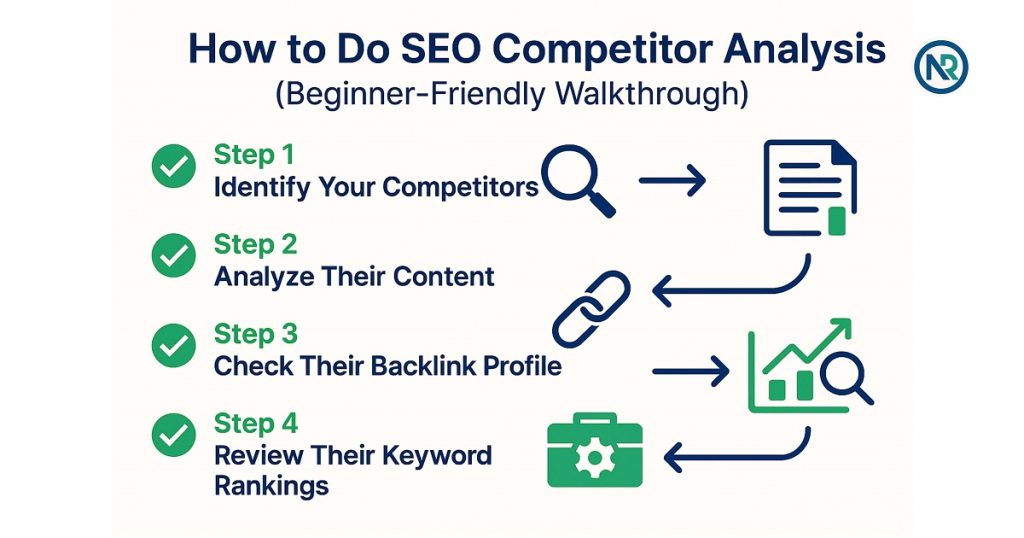
How to Do SEO Competitor Analysis (Beginner-Friendly Walkthrough)
🔹 Step-by-Step Process for Beginners
- If you’re new to this, don’t stress—it’s easier than it sounds.
- Think of SEO competitor analysis as doing research before a test you really want to pass.
- All you need is the right process, a few tools, and curiosity.
✅ Here’s how I do it step by step.
🔹 Step 1: Identify Your Competitors
- Start by Googling the keywords you want to rank for.
- Look at the top 5–10 results on the first page—they’re your real SEO competitors.
- Don’t assume big brands are your only rivals. Sometimes, small blogs outrank everyone.
✅ The sites ranking on page one are the ones you should study.
🔹 Step 2: Analyze Their Content
- Look at how their content is written. Is it long or short? Simple or detailed?
- Check how they use headings, images, internal links, and CTAs.
- Ask yourself: “What are they doing that I’m not?”
✅ Great content doesn’t always mean complex—it means clear, helpful, and relevant.
🔹 Step 3: Check Their Backlink Profile
- Use tools like Ubersuggest or Ahrefs to see who’s linking to them.
- Backlinks are a huge part of why they rank well.
- Look for patterns: are they getting links from blogs, forums, or directories?
✅ Good backlinks = better authority = better rankings.
🔹 Step 4: Review Their Keyword Rankings
- Use tools to see what keywords they rank for that you might be missing.
- Look for low-difficulty, high-intent keywords you can target.
- These are often hidden gems that don’t show up in basic keyword research.
✅ This is how I found some of my top-performing keywords—just by checking a competitor’s site.
🔹 Step 5: Use the Right Tools (Free + Paid)
- Free tools: Google Search, Ubersuggest, Google Search Console.
- Paid tools: Ahrefs, SEMrush, Surfer SEO.
- You don’t need all of them—start with what you can access and scale as needed.
✅ Ubersuggest was my first tool. It opened my eyes to how much I was missing.
🔹 Personal Insight: “I Wish I Had Known This Tool Earlier…”
- I spent months guessing before I used Ahrefs for the first time.
- One simple keyword gap report showed me five topics I had never covered—but my competitors had.
- I wrote content around them, and within 3 weeks, I saw real traffic coming in.
✅ That tool saved me months of trial and error.
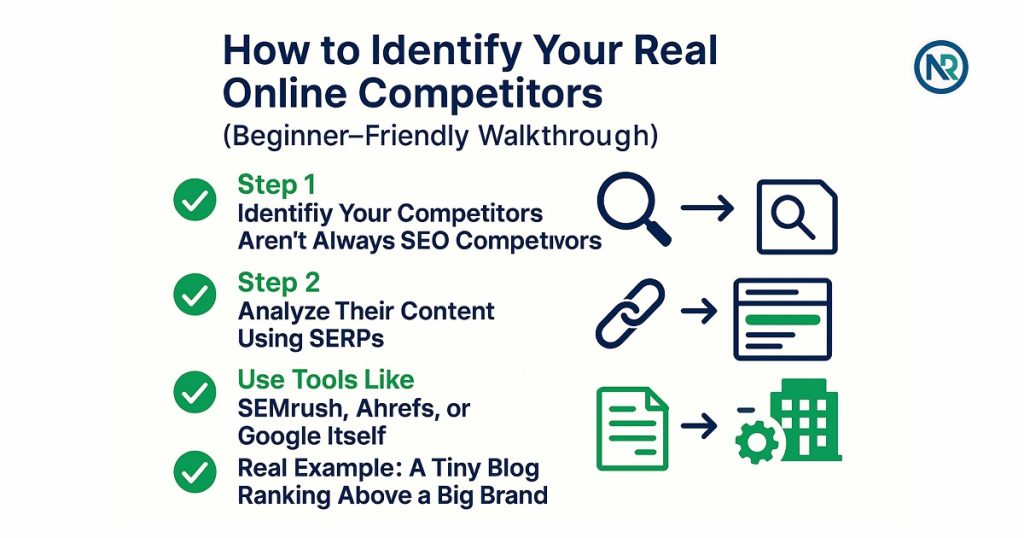
How to Identify Your Real Online Competitors
🔹 Business Competitors Aren’t Always SEO Competitors
- Just because someone sells what you sell doesn’t mean they’re ranking where you want to rank.
- SEO competitors are the ones who show up in Google when your ideal customer searches.
- That could be a blog, a YouTube channel, or a small affiliate site.
- ✅ SEO competitor analysis shows you who’s fighting for your traffic—not just your market.
🔹 How to Identify SEO Competitors Using SERPs
- Search your main keywords on Google.
- Skip the ads and check who ranks on page one.
- Pay attention to blogs, directories, and niche websites—even if they’re not in your country.
- ✅ If they rank for your target keywords, they’re a competitor in the SEO world.
🔹 Use Tools Like SEMrush, Ahrefs, or Google Itself
- Google: The easiest way to spot real SEO competitors. Just type and observe.
- SEMrush: Use the “Organic Research” tab to find domains competing with yours.
- Ahrefs: Go to “Competing Domains” and see who shares your keywords.
- ✅ You don’t need every tool—pick one that fits your style and budget.
🔹 Real Example: I Found a Tiny Blog Ranking Above a Big Brand
- I once thought a large national brand was my main competitor.
- But when I ran an SEO audit, I found a personal blog ranking higher for the same keywords.
- Their posts were helpful, simple, and got lots of natural backlinks.
- ✅ That changed how I approached content—less flashy, more focused.

Where to Find SEO Competitors (and What to Look For)
🔹 Find Competitors Through Organic Search
- Open Google and type in your target keywords.
- Look at the first page of results—those sites are your real SEO competitors.
- They may not sell what you sell, but they rank where you want to.
- ✅ If they show up for your keywords, they’re worth paying attention to.
🔹 Check Google Maps and Local Results
- For local businesses, the map pack matters—a lot.
- Search for a location-based term (like “hair salon near me”).
- The top listings on the map are your local SEO competitors.
- ✅ They may be small, but they’re winning the clicks you want.
🔹 Use Tools Like Google Search Console and Ubersuggest
- Google Search Console shows what keywords you rank for—and who else does too.
- Ubersuggest lets you see keyword overlap between your site and others.
- Both tools are beginner-friendly and free to start with.
- ✅ These give clear clues about who’s competing for the same search space.
🔹 Lessons From My Own SEO Audits
- I once ignored a tiny blog because they weren’t a “big brand.” Turns out, they were beating me for three top keywords.
- Another time, a client focused on business rivals while missing actual ranking threats.
- Now, I always look at the SERPs first—real data beats guesswork every time.
- ✅ SEO competitor analysis helps you stop guessing and start growing.
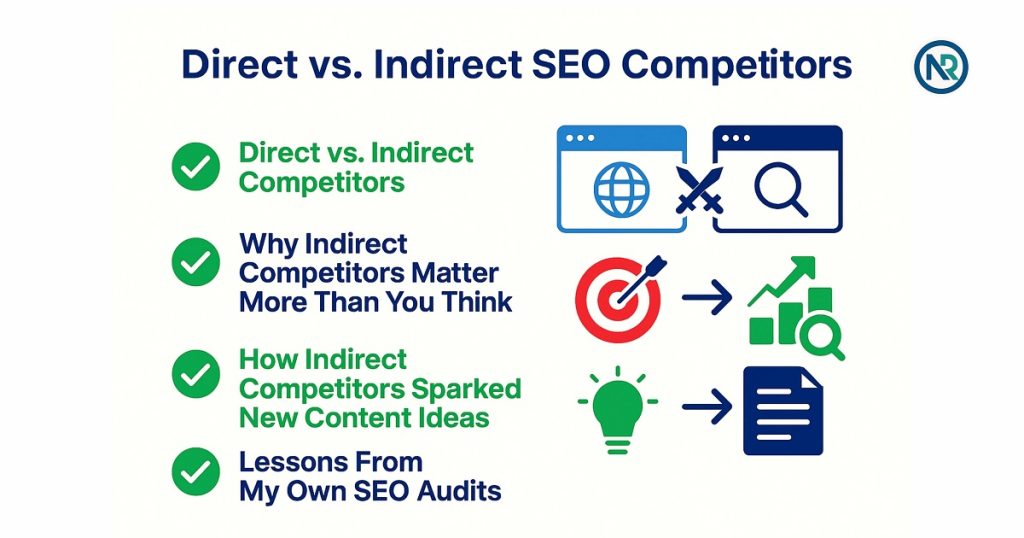
Types of SEO Competitors: Direct vs Indirect
🔹 Direct vs Indirect SEO Competitors: What’s the Difference?
- Direct SEO competitors are sites that offer the same service or product and rank for the same keywords.
- Indirect competitors may not sell what you sell—but they still rank for your target keywords.
- A fitness blog, for example, might compete with a gym’s website on “best home workouts,” even though they’re not selling memberships.
- ✅ In SEO, it’s not just who you do business with—it’s who ranks next to you in Google.
🔹 Why Indirect Competitors Matter More Than You Think
- Indirect competitors often rank high because their content is hyper-focused and valuable.
- They attract the same audience you’re trying to reach—even if their goals are different.
- Ignoring them means missing out on real insights about user intent and content strategy.
- ✅ They may not take your customers, but they might steal your traffic.
🔹 How Indirect Competitors Sparked New Content Ideas
- I once noticed a parenting blog ranking for a keyword I had targeted in the health niche.
- Their article was simple, helpful, and full of personal stories—something I hadn’t considered.
- That inspired me to write a fresh piece from a more personal angle. It outranked three commercial pages.
- ✅ Sometimes your best ideas come from people outside your bubble.
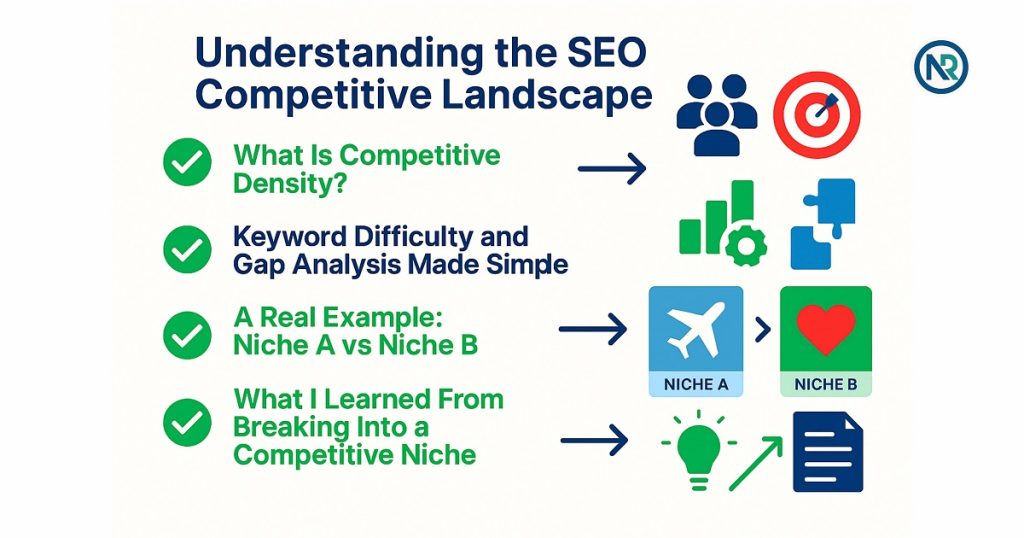
Understanding the SEO Competition Landscape
🔹 What Is Competitive Density?
- Competitive density shows how many websites are trying to rank for the same keyword.
- High density means more rivals and more effort to win the top spot.
- Low density usually means easier rankings—but often less traffic.
- ✅ It helps you choose your battles smartly during SEO competitor analysis.
🔹 Keyword Difficulty and Gap Analysis Made Simple
- Keyword difficulty tells you how hard it is to rank for a keyword.
- Gap analysis helps you spot keywords your competitors rank for—but you don’t.
- When you find low-difficulty, high-intent keywords, you unlock growth with less effort.
- ✅ This combo is a game-changer for beginners working in competitive markets.
🔹 A Real Example: Niche A vs Niche B
- I worked with a travel site and a health blog at the same time.
- Travel had lower keyword difficulty and more content gaps I could target.
- Health was packed with tough competition and high-authority domains everywhere.
- ✅ Knowing the SEO landscape helped me build a faster plan for the travel site—and a long-term plan for health.
🔹 What I Learned From Breaking Into a Competitive Niche
- At first, I chased high-volume keywords and got nowhere.
- Later, I focused on easier wins with solid content, and the results improved.
- I learned to update old posts, use better structure, and build internal links.
- ✅ SEO competitor analysis taught me that smart, steady moves beat aggressive guesswork.
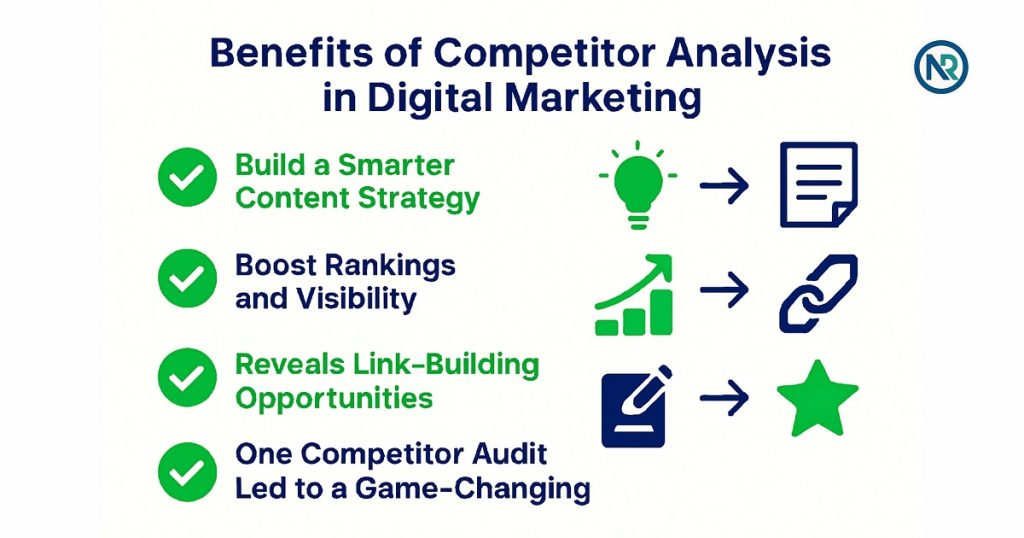
Benefits of Competitor Analysis in Digital Marketing
🔹 It Helps You Build a Smarter Content Strategy
- Before I knew better, I wrote content just based on gut feeling.
- Sometimes it worked, but often it didn’t rank at all.
- Then I used SEO competitor analysis to see what others were writing—and why they were winning.
- ✅ It gave me a clear direction. Now I write with purpose, not guesswork.
🔹 It Boosts Your Rankings and Visibility
- I noticed top-ranking sites had clear headlines, structured content, and strong internal links.
- I copied what worked, made it my own, and saw real improvements in rankings.
- One blog post jumped from page two to the top five—just by fixing structure and intent.
- ✅ Studying your SEO competitors helps you write content Google actually wants to rank.
🔹 It Reveals Link-Building Opportunities
- I checked where my competitors got their backlinks.
- Some came from round-up posts, others from guest articles or local directories.
- I followed the same steps and got a few easy wins—no cold emails, no begging.
- ✅ You don’t always need fancy outreach—just smart observation.
🔹 One Competitor Audit Led to a Game-Changing Guest Post
- I saw a backlink from a site I loved reading myself.
- Turns out, they accepted guest posts. So I pitched my story—and they said yes.
- That single article brought me traffic, credibility, and even a paid client.
- ✅ All of that happened because I took 10 minutes to look at one competitor’s backlinks.
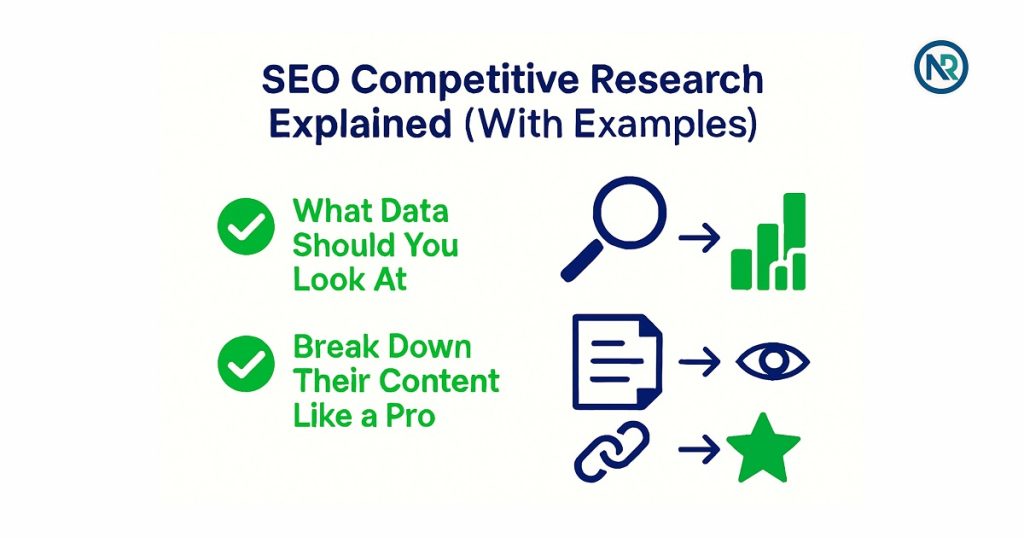
SEO Competitive Research Explained (With Examples)
🔹 What Data Should You Look At?
- Start by finding keyword overlap—see which keywords your competitors rank for that you don’t.
- Look at content formats: are they using how-tos, list posts, or videos?
- Check for SERP features like featured snippets, FAQs, and review stars.
- ✅ SEO competitor analysis helps you understand what’s working, not just who’s ranking.
🔹 Break Down Their Content Like a Pro
- Ask: How long is the post? Is it skimmable? Does it answer questions clearly?
- Note how they use headings, images, internal links, and calls to action (CTAs).
- Look for weak spots—maybe the intro is vague or the structure is hard to follow.
- ✅ This helps you create content that’s easier to read and more useful.
🔹 A Real Example: How I Beat a Top-Ranking Post
- I once found a post ranking #1 for a keyword I really wanted.
- The content was okay—but the paragraphs were long, and it had no real examples.
- I wrote a version with shorter sentences, personal tips, and a clear layout.
- Within three weeks, my post was ranking in the top 3.
- ✅ All it took was one focused update based on smart competitor research.
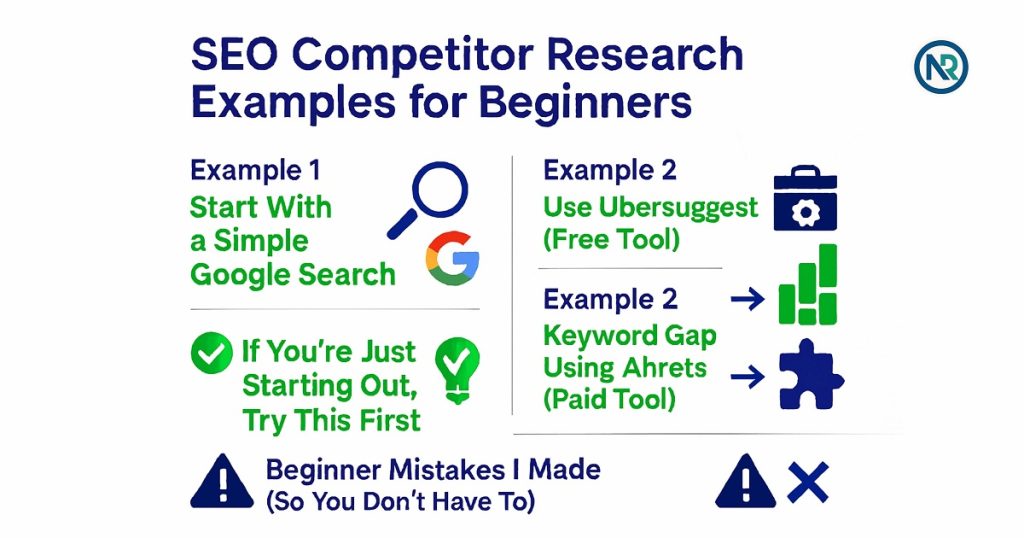
SEO Competitor Research Examples for Beginners
🔹 Example 1: Start With a Simple Google Search
- Go to Google and search for a keyword you’d like to rank for.
- Look at the top 5–10 organic results. Open those pages and study their content.
- Check how they structure the article, what questions they answer, and what makes it helpful.
- ✅ This is the easiest way to begin SEO competitor analysis—no tools required.
🔹 Example 2: Use Ubersuggest (Free Tool)
- Head to ubersuggest.com and enter your domain or a competitor’s.
- Click on “SEO Explorer” → “Top SEO Pages” to see their best-performing content.
- You’ll find keyword ideas, backlinks, and estimated traffic—all in one place.
- ✅ This helped me find three topics I’d never considered—and one turned into a high-traffic blog post.
🔹 Example 3: Keyword Gap Using Ahrefs (Paid Tool)
- In Ahrefs, go to “Content Gap” and enter your domain alongside 2–3 competitors.
- The tool shows keywords they rank for that you don’t.
- Sort by volume and difficulty to find low-hanging fruit.
- ✅ This is how I found a keyword with 2,400 monthly searches that brought me steady traffic for months.
🔹 If You’re Just Starting Out, Try This First
- Use Google. It’s free, fast, and still one of the best tools out there.
- Search your topic, open the top results, and jot down what they do well.
- Look for structure, tone, visuals, and what questions they answer.
- ✅ You don’t need to be technical—you just need to be curious and observant.
🔹 Beginner Mistakes I Made (So You Don’t Have To)
- I focused too much on big competitors and ignored small blogs.
- I chased keywords that were way too competitive in the beginning.
- I skipped analyzing content quality—and just looked at word count.
- ✅ Now, I look at intent, formatting, and real value—not just stats.
Final Thoughts: Mastering SEO Through Strategic Competition Awareness
🔹 Key Takeaways
SEO competitor analysis isn’t spying—it’s learning what works.
You don’t need expensive tools to start. Curiosity and consistency go a long way.
Focus on who’s ranking, how their content is built, and what gaps you can fill.
✅ Smart SEO is about strategy, not guesswork.
🔹 Encouragement: Start Small and Be Consistent
You don’t have to analyze 20 sites at once. Just pick one.
Spend 10 minutes looking at their best content. What are they doing right?
Take notes, tweak your content, and try something new—then repeat.
✅ Like the gym, SEO rewards those who show up regularly—not those who go all-in once.
🔹 My Challenge to You: Take Action Today
Pick one keyword you care about. Search it in Google.
Click on the top 3 results and study what they’re doing that you aren’t.
Write down 3 things you can improve in your next post.
✅ Just one simple competitor analysis can shift your entire SEO mindset.
🔚 Wrapping It Up
SEO can feel like a maze. But with the right mindset—and smart SEO competitor analysis—you’re not walking it blind. You’re learning from those who’ve already walked ahead. That’s how I started, and it’s exactly what I help others do now through Nurul Reach.
At Nurul Reach, I combine data, real-life experience, and simple strategies that work—even if you’re just starting out. Whether you’re building a new site or trying to revive an old one, I’m here to guide you step by step. No fluff. No jargon. Just results.
✅ So go on—analyze one competitor today, and if you ever feel stuck, you know where to find me.
FAQ Section – SEO Competitor Analysis
❓ What is SEO competitor analysis?
✅ Answer:
SEO competitor analysis finds which sites rank for your target keywords and shows what they do well, so you can improve your content and rankings.
❓ Why is SEO competitor analysis important?
✅ Answer:
It helps you understand what works, find keyword gaps, improve content, and build smart strategies that increase traffic and visibility.
❓ When should I run an SEO competitor analysis?
✅ Answer:
You should run SEO competitor analysis when starting a website, planning new content, or if your traffic drops or stops growing.
❓ How do beginners do SEO competitor analysis?
✅ Answer:
Start by searching your keyword on Google. Study the top results, check their keywords, content, and backlinks using free tools like Ubersuggest.
❓ Who are my real SEO competitors?
✅ Answer:
Your real SEO competitors are the websites ranking on page one for your target keywords—even if they’re not your business rivals.
❓ Where can I find SEO competitors?
✅ Answer:
Use Google, Ubersuggest, or tools like Ahrefs. Search your keywords and note which sites show up most often in the results.
❓ What’s the difference between direct and indirect SEO competitors?
✅ Answer:
Direct SEO competitors sell what you sell. Indirect ones rank for the same keywords but may offer blogs, tools, or related info.
❓ What tools help with SEO competitor research?
✅ Answer:
Free tools include Google and Ubersuggest. Paid tools like Ahrefs and SEMrush give deeper insights into keywords and backlinks.
❓ Can SEO competitor analysis improve my rankings?
✅ Answer:
Yes, it helps you learn what high-ranking pages do right, so you can build better, more relevant content that earns higher rankings.
❓ Is SEO competitor analysis only for experts?
✅ Answer:
No! With simple tools and steps, anyone can start. Even beginners can find keywords, content gaps, and backlink ideas fast.
