
Why Most Websites Are Invisible in AI Search
Struggling to rank in Google even after “doing SEO”?
Getting traffic—but no visibility in AI-generated answers like Google AI Overviews?
Here’s the hard truth:
Most websites fail not because of lack of effort…
They fail because they are optimized for old SEO, not AI-driven search systems.
Search has changed.
Today, platforms powered by Large Language Models (LLMs) don’t just rank pages—they understand, summarize, and recommend content.
👉 That means if your content isn’t optimized for:
- AI understanding
- Contextual relevance
- Entity relationships
You won’t appear in AI Overviews—no matter how good your content is.
As an SEO Problem Solver at Nurul Reach, I’ve helped businesses fix this exact issue by combining SEO + AEO + AIO + GEO + EEAT frameworks.
Let’s break down how you can do the same.
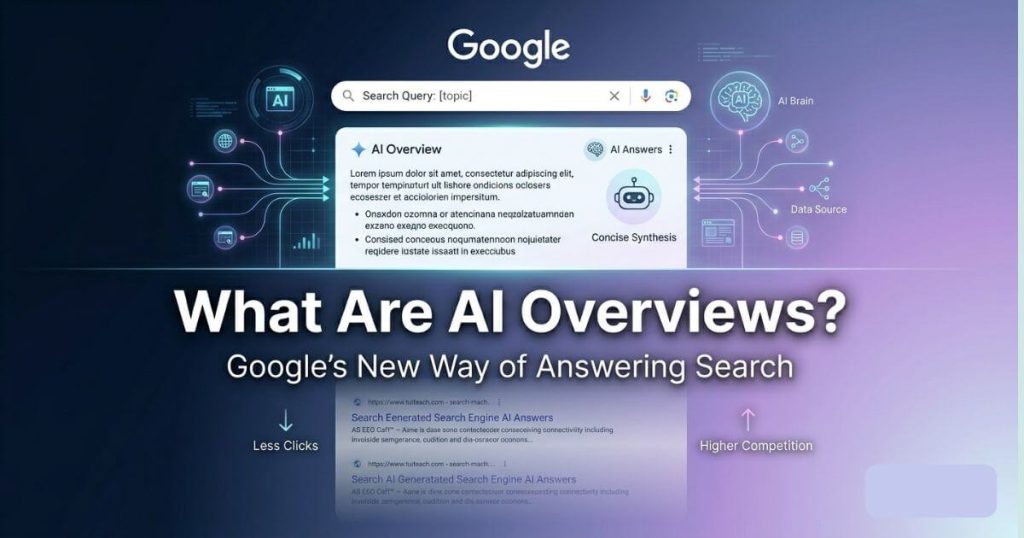
What Are AI Overviews & Why Do They Matter?
AI Overviews are AI-generated summaries shown in search results that combine multiple sources to directly answer user queries, reducing the need to click on websites.
AI Overviews are Google’s next evolution of search.
Instead of showing 10 blue links, Google now:
- Understands user intent
- Pulls data from multiple sources
- Generates a direct answer
👉 This means:
- Fewer clicks
- Higher competition
- More importance on authority + clarity
Why Most Websites Fail to Rank in AI Overviews
Common Problems:
- ❌ Content is keyword-focused, not intent-focused
- ❌ No clear answers (AI can’t extract information easily)
- ❌ Weak topical authority
- ❌ No entity-based structure
- ❌ Poor EEAT signals
👉 Result:
Your content exists… but AI ignores it.
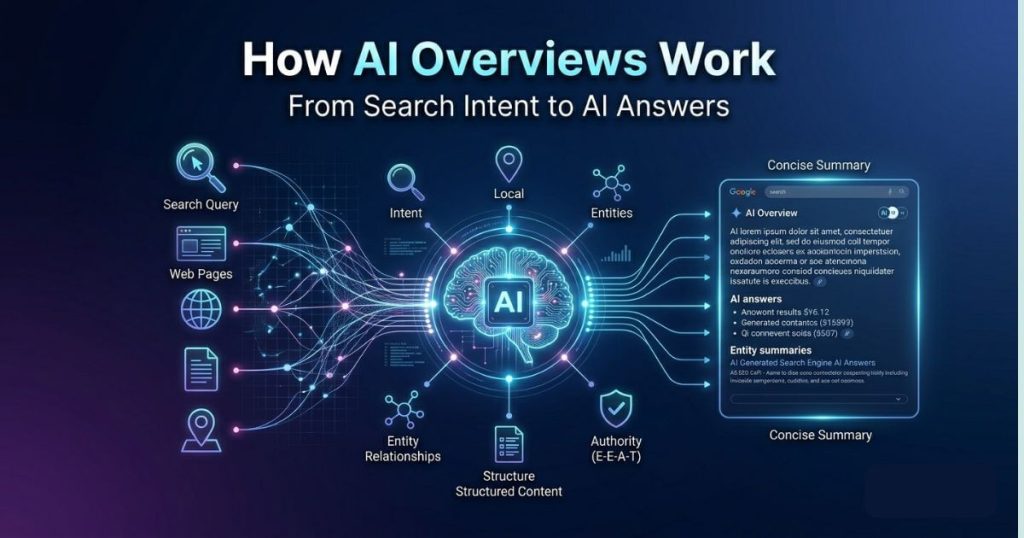
How Do AI Overviews Actually Work?
AI Overviews analyze user intent, extract relevant data from high-authority pages, and generate summarized answers using NLP and semantic understanding.
AI systems evaluate:
1. Search Intent Matching
- Informational
- Local
- Commercial
2. Entity Relationships
- Business
- Location
- Service
- Topic clusters
3. Content Structure
- Clear headings
- Direct answers
- Logical flow
4. Authority Signals (EEAT)
- Experience
- Expertise
- Trustworthiness
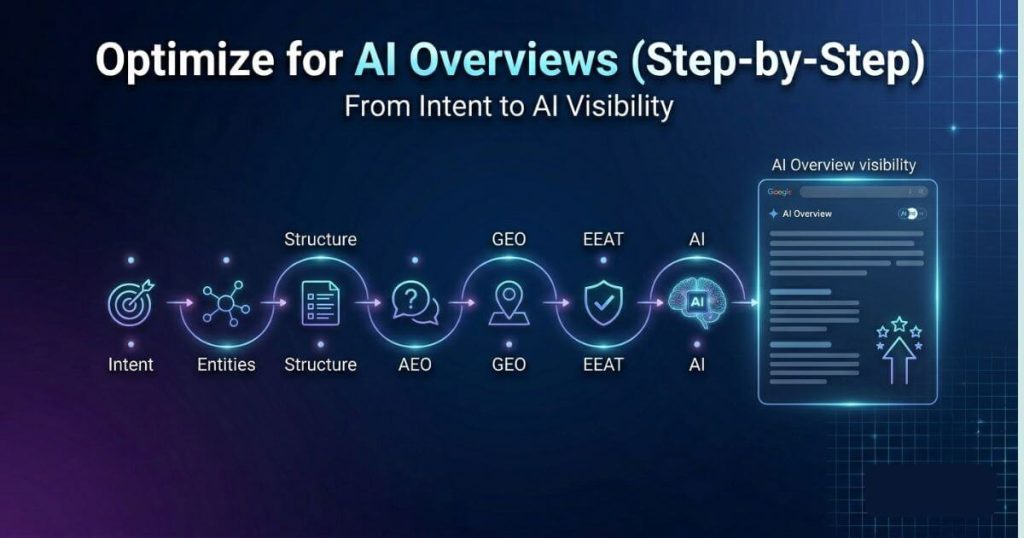
How to Optimize for AI Overviews Step-by-Step Strategy
1. Match Search Intent First (Foundation Step)
Problem:
Most content targets keywords—not intent.
Solution:
Focus on why the user is searching
Example:
Keyword: “Local SEO expert near Connecticut”
👉 AI expects:
- Direct answer
- Expert explanation
- Local context
Pro Tip:
Answer the query in the first 2–3 lines
2. Use Entity-Based SEO (Critical for AI)
What is Entity SEO?
Entities are:
- People
- Places
- Services
- Concepts
AI connects them to understand meaning.
Example Structure:
- Local SEO → Business Growth → Google Rankings → Leads
How to Optimize:
- Use related terms naturally
- Build topic clusters
- Maintain semantic consistency
3. Structure Content for AI Readability
AI Loves Structured Content
Use:
- Clear H2/H3 headings
- Bullet points
- Short paragraphs
- Logical flow
Add “Answer Blocks”:
Each section should include:
👉 Direct answer (40–60 words)
4. Optimize for AEO (Answer Engine Optimization)
Problem:
Content is too long, unclear, and unfocused.
Solution:
Make answers extractable
Use:
- Question-based headings
- Short answers
- FAQ sections
- Featured snippet style content
5. Apply GEO (Generative Engine Optimization)
AI values local relevance
Add:
- Location-based context
- Local intent keywords
- Business-specific scenarios
Example:
Instead of:
“SEO services help businesses”
Write:
“Local SEO services help small businesses generate leads in their target area”
6. Strengthen EEAT Signals (Authority Matters)
AI Prioritizes Trust
Add:
- Real experience
- Case insights
- Practical examples
Example:
Instead of:
“SEO improves rankings”
Write:
“After fixing indexing issues and improving internal linking, rankings increased within 60 days”
7. Optimize for LLM Understanding (AIO Strategy)
LLMs prefer:
- Clear explanations
- Context-rich content
- Logical flow
Avoid:
- Fluff
- Over-optimization
- Keyword stuffing
Focus on:
- Depth
- Clarity
- Relevance
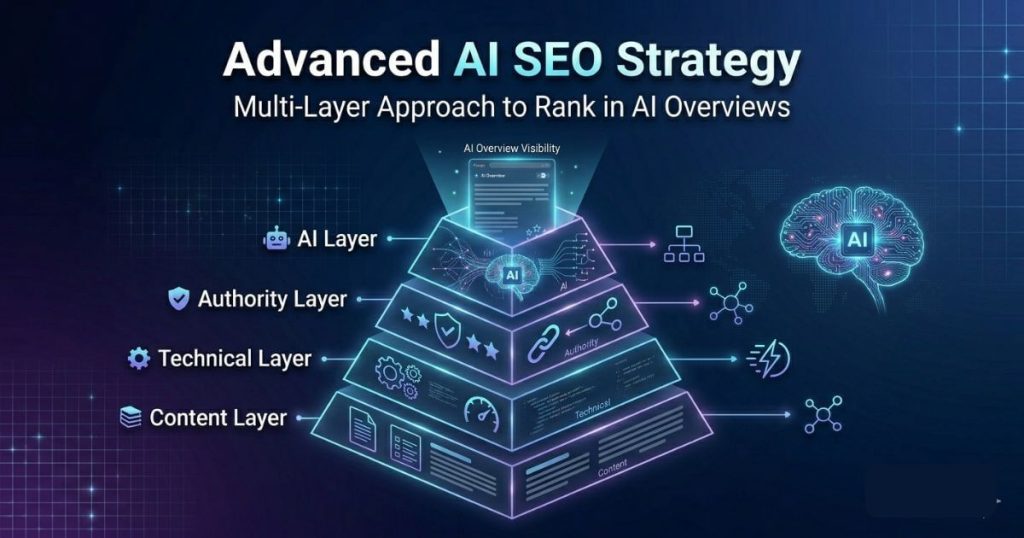
Advanced AI SEO Strategy (Multi-Layer Approach)
To dominate AI Overviews, combine these layers:
Content Layer
- Long-form NLP content
- Question-based sections
- Answer blocks
Technical Layer
- Schema markup
- Fast loading speed ( Test here)
- Crawl optimization
Authority Layer
- EEAT signals
- Backlinks
- Brand mentions
AI Layer
- Semantic relationships
- Entity mapping
- Contextual clarity
Example of AI-Optimized Content Structure
Instead of writing:
❌ “SEO is important for businesses”
Write:
✅ “SEO helps local businesses increase visibility, attract targeted traffic, and generate qualified leads through optimized search presence.”
👉 Notice:
- Clear
- Specific
- Context-rich
Internal Linking Strategy (Boost AI Understanding)
To strengthen authority, connect your content naturally:
- Learn more on our Homepage
- Discover our expertise on About Us
- Get help via Contact
- Explore packages on Pricing
👉 Internal links help AI:
- Understand site structure
- Build topical authority
- Improve content relevance
Real Insight: Why AI SEO Is the Future
Traditional SEO:
- Rank pages
AI SEO:
- Select answers
👉 Big difference.
If your content is not:
- Clear
- Structured
- Authoritative
AI won’t use it.
How Nurul Reach Helps You Rank in AI Overviews
At Nurul Reach, we don’t just “do SEO”…
We solve problems like:
- Indexing issues
- Low rankings
- No conversions
- Poor visibility in AI search
Our Approach:
- SEO + AEO + AIO + GEO integration
- Entity-driven content strategy
- Technical + content + authority optimization
👉 Result:
More visibility, better rankings, higher conversions.
Final Thoughts
If your website:
- Isn’t ranking
- Isn’t getting leads
- Isn’t appearing in AI Overviews
👉 It’s time to fix the real problem.
- Learn more on our Homepage
- Understand our expertise on About Us
- Get in touch via Contact
- Check affordable plans on Pricing
More Short FAQ
1. What is AI Overview in SEO?
AI Overview is a Google feature that generates summarized answers using multiple sources, helping users get instant information without visiting websites.
2. How do I rank in AI Overviews?
Focus on search intent, structured content, entity SEO, and EEAT signals. Provide clear answers and optimize for AI readability.
3. What is AEO in SEO?
AEO (Answer Engine Optimization) helps content get selected as direct answers by search engines and AI systems.
4. Why is my content not appearing in AI search?
Your content may lack structure, authority, or clarity, making it hard for AI to extract and trust your information.
5. Is traditional SEO still important?
Yes, but it must evolve. Combine SEO with AIO, AEO, and GEO strategies to stay competitive in AI-driven search.
